CONCEPT DOMAIN - SOF - Business Software Operating Model
| Description | Pattern Domain The SOF - Business Software Operating Model domain provides concepts and abstractions shared by all Business Software Systems. |
|---|---|
| External references |
 OpenGroup - ArchiMate - Layer - Application Layer OpenGroup - ArchiMate - Layer - Application Layer
|
| Dictionary |  SysFEAT Enterprise concepts
 |
| Parent Domain |  SOF - Business Resource Operating Models
 |
| Domain dependencies |  EA Pattern - Physical Data Domain
Logical Application Architecture
People & Accountability
SOF - Business Resource Operating Pattern (B-SOF)
SOF - Business System Operating Pattern
SOF - Resource System Operating Pattern (R-SOF)
EA Pattern - Physical Data Domain
Logical Application Architecture
People & Accountability
SOF - Business Resource Operating Pattern (B-SOF)
SOF - Business System Operating Pattern
SOF - Resource System Operating Pattern (R-SOF) |
DOMAIN CONCEPT GRAPH
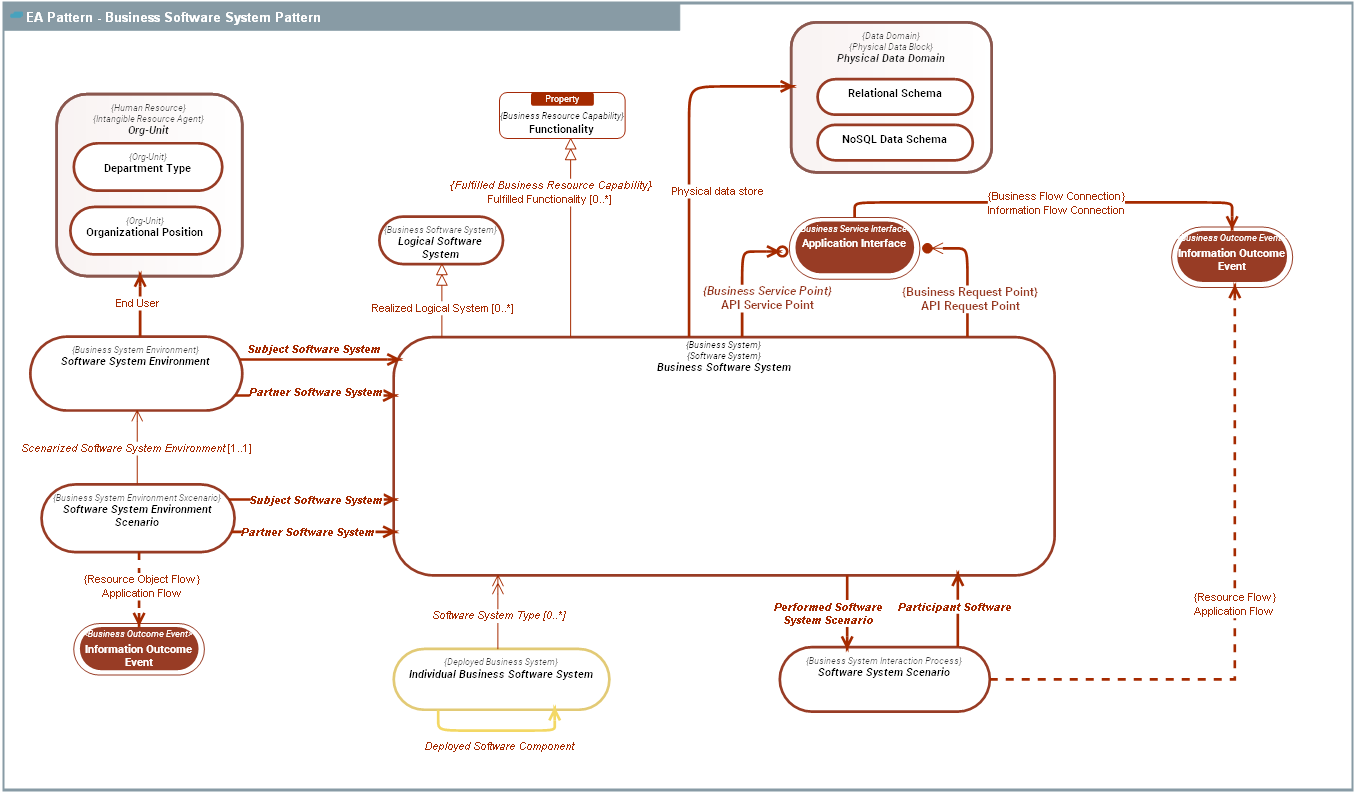
CONCEPT DESCRIPTIONS
ABSTRACT CONCRETE
| Concept | Description |
|---|---|
 Business Software System
 |
A Business Software System is a Business System used by Business Operations, that represents all granularities of software - ranging from MicroServices to enterprise wide Application Systems - used by Business Operations. All Business Software Systems share the following characteristics: 1) They provide Functionalitys. 2) They expose APIs (Application Interfaces) through which they deliver Information Outcome Events. 3) They handle datastores defined by Physical Data Domains. 4) They perform and participate to System Processes.
|
 Individual Business Software System
 |
|
|
Logical Software System |
A Logical Software System is logical specification of a Business Software System, which is independant from the Business Software System physical implementation. For instance, "Human Resource ERP System" is a Logical Application System, while "SAP HR System", "Sage HR System", "Kronos HR System" are Application Systems. |
|
Org-Unit Type |
An Org-Unit Type is a type of Human Resource that represent a unit of social groups within an organization, responsible for operating one or more enterprise's Business Functions. |
|
Physical Data Domain |
A Physical Data Domain is subset of the metadata of an enterprise’s data store. Each Physical Data Entity in a Physical Data Domain has CRUD characteristics. For instance, the "Client" Table in the "Sales" Physical Data Domain, has all CRUD characteristics. Physical Data Domains define functional data boundaries used both for Data Allocation to Business Systems (see Resource Agent Store) and data governance for data stewardship (see Data Catalog). |
|
Software System Environment |
A Software System Environment is an operating context in which a Business Software System defines its interactions with its partners (Partner System) in the form of API connections (Software Connection). It also represents End Users who interact with the system. |
|
Software System Environment Scenario |
A Software System Environment Scenario is a story involving the partners of a Business Software System (Partner System), interacting in order to produce Information Outcome Events in a specific Eco-System (Software System Environment). This includes: - A course of events represented by Object Flows depicting the story towards the delivery of expected Information Outcome Events. - Interacting partners who participate to the story in the considered Eco-System.
|
|
Software System Scenario |
A Software System Scenario is a story involving the components of a Business Software System, interacting in order to produce Information Outcome Events. This includes: 1) A course of events represented by Application Flows depicting the story towards the delivery of expected Information Outcome Events. 2) Interacting Business Software Systems who participate to the story.
|
 OMG - UAF - Software

LOGICAL FORMULATION
AGDA RDF