CLASS OF CLASS OF INDIVIDUAL - Organizational Position
| Description |
An Organizational Position is a type of position held by people when part of a Department Type. Examples: - Sales representative - Developer - Storekeeper - Architect
|
||
|---|---|---|---|
| External references |
 OMG - UAF - Post OpenGroup - ArchiMate - Business-Actor OpenGroup - TOGAF - Definition - Role UCF Glossary - Position Description OMG - UAF - Post OpenGroup - ArchiMate - Business-Actor OpenGroup - TOGAF - Definition - Role UCF Glossary - Position Description | ||
| Super Types |  Org-Unit Type (from partition:
Systemic Levels of Org-Unit Type)
Org-Unit Type (from partition:
Systemic Levels of Org-Unit Type) | ||
| Dictionary |  SysFEAT Enterprise concepts
 | ||
| Systemic Levels |  Micro
Micro | ||
| Lexical Scope |  Architecture Container
 | ||
| Framework Mapping |
TOGAF - Enterprise Metamodel Mapping : Actor UAF - Strategy : Post UAF - Personal Views : Post UAF - Operational Views : Post UAF - Project Views : Post TOGAF - Enterprise Metamodel Mapping : Role |
RELATIONSHIPS
Simple Graph Graph & Inheritance Table
Simple Graph
Composition: ➝ Classification: ➝ Specialization: ➝ Instance Of: --> Enumerated definition: ➝ Syntax: ➝
LOGICAL FORMULATION
LOGIC-AGDA RDF
File: 076d151c5a5e1561.agda
SEMANTIC TAXONOMY
Sub-Types Super-Types
SUB-TYPES
Click node rectangle to collapse/expand one level. Click triangle for full recursive collapse/expand. Double-click on a node to open its URL. Hover for description.
BORDERS


INTERNAL STRUCTURE
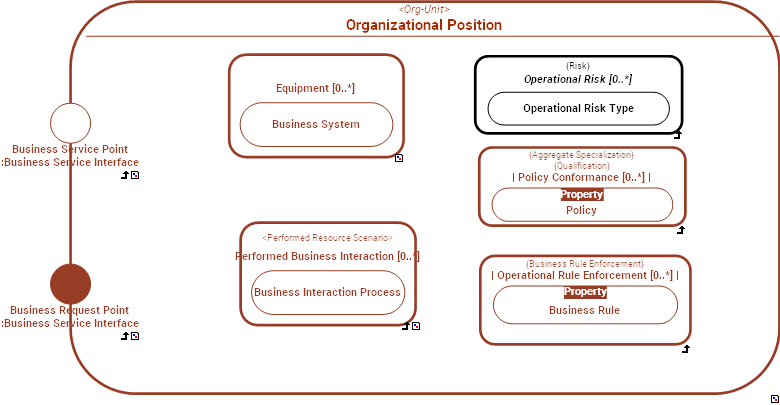
SAMPLES
| Name | Description | |
|---|---|---|
 Position Type - Chief of Operations & Business Development Position Type - Chief of Operations & Business Development | The chief operating officer (COO) is a senior executive tasked with overseeing the day-to-day administrative and operational functions of a business. The COO typically reports directly to the chief executive officer (CEO) and is considered to be second in the chain of command. |