CONCEPT DOMAIN - SOF - Business System Operating Pattern
| Description | The SOF - Business System Operating Pattern domain defines concepts and relationships used to model how a Business System operates/functions in its Operating Eco-System.. It includes Business Systems, System Processes, Business System Interaction Processs, System Rules, Functionality(ies), Information Outcome Events. |
|---|---|
| Dictionary |  SysFEAT Enterprise concepts
 |
| Parent Domain |  SOF - Business Resource Operating Models
 |
| Domain dependencies |  Architecture Assets
EA Pattern - Data Domain
EA Pattern - Physical Data Domain
EA Pattern - Technology Operating Pattern
SOF - Business Resource Operating Pattern (B-SOF)
System Operating Framework - SOF
Architecture Assets
EA Pattern - Data Domain
EA Pattern - Physical Data Domain
EA Pattern - Technology Operating Pattern
SOF - Business Resource Operating Pattern (B-SOF)
System Operating Framework - SOF |
DOMAIN CONCEPT GRAPH
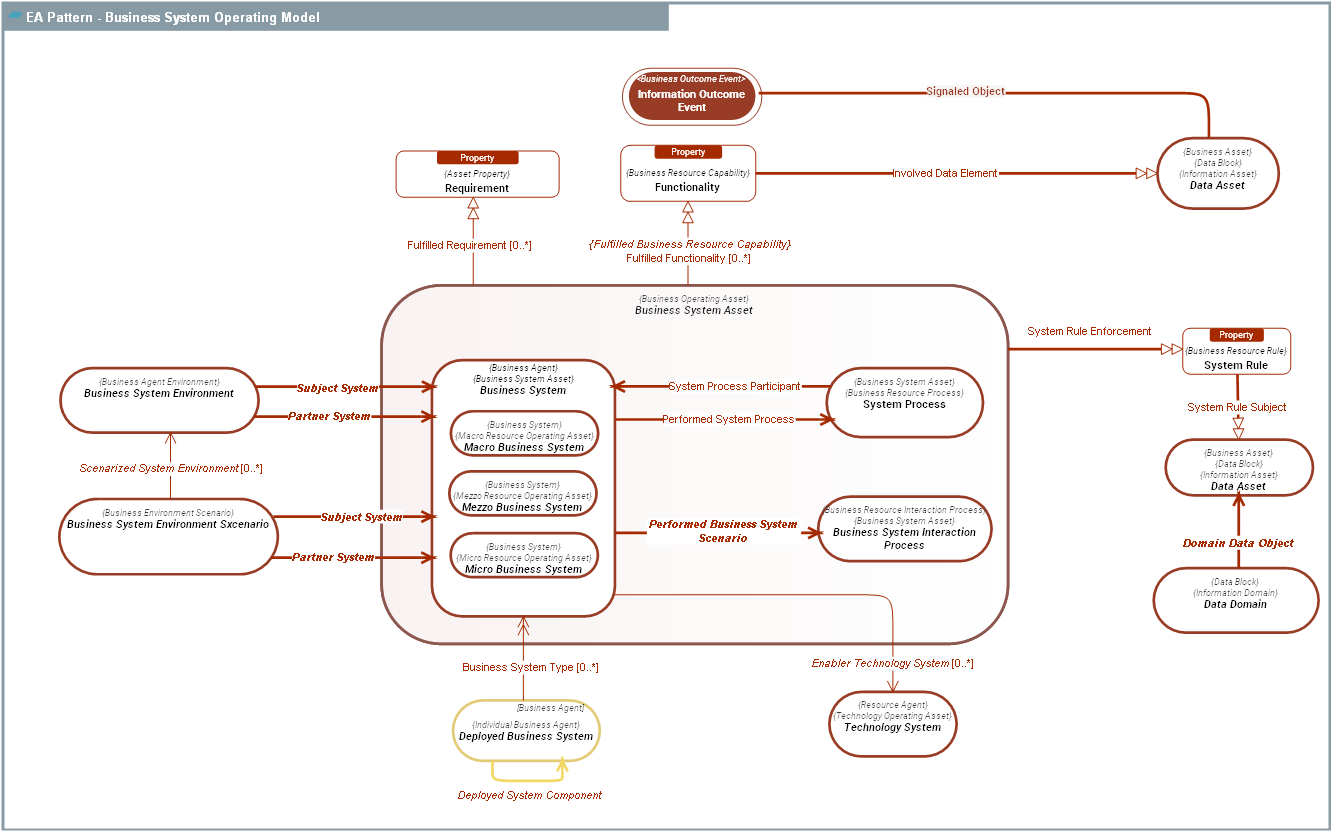
CONCEPT DESCRIPTIONS
ABSTRACT CONCRETE
| Concept | Description |
|---|---|
 Business System
 |
A Business System is a man made artifact (Concrete Hardware System or Business Software System) which exposes Functionalityies and can produce Business Outcome Events. A Business System performs System Processes and participates to System Processes or to Business Processes. In System Processes, a Business System is always an active participant (System Process Participant). In Business Processes, a Business System is either an active participant (Automated Participant) or an Instrument used by Org-Unit Types.
|
|
Business System Asset |
A Business System Asset is man made resource that is a means to achieve Business Outcome Events. |
|
Business System Environment |
A Business System Environment is an operating context in which a Business System defines its interactions ( Business Service Channel) with its partners (Partner System), to produce and deliver its Business Outcome Events. |
|
Business System Environment Sxcenario |
A Business System Environment Sxcenario is a story involving the partners of a Business System (Partner System), interacting in order to achieve Business Outcome Events in a specific Eco-System (Business System Environment). This includes: - A course of events represented by Object Flows depicting the story towards the delivery of expected Outcomes. - Interacting partners who participate to the story in the considered Eco-System. |
|
Business System Interaction Process |
A Business System Interaction Process is a black-box behavior involving the components of a Business System, interacting in order to produce Business Outcome Events. This includes: 1) A course of events represented by Resource Flows depicting the steps towards the delivery of expected Business Outcome Events. 2) Interacting Business Systems who participate to the story. |
|
Data Asset |
A Data Asset represents the abstract structure of any kind of data that can be processed and memorized by a Business Software System. A Data Asset is either a Data Entity or a Data Property. Only Data Entitys can have identity and states. Data Propertys only handle raw data. Data Assets are managed in Data Catalogs.
|
|
Data Domain |
A Data Domain is subset of the enterprise’s data that are meant to be manipulated together in the context of business operations. For instance, a "Sales" Data Domain contains at least the following entities: Customers, Orders, Products. Each Data Entity in a Data Domain has CRUD characteristics. For instance, Products are read-only in a "Sales" Data Domain, while Customers and Orders have all CRUD characteristics. Data Domains define functional data boundaries used both for Data Allocation to Business Systems (see Data Stores) and Data Governance for data stewardship (Data Catalogs). |
 Deployed Business System
 |
A Deployed Business System is a man made Individual Business Agent that delivers business outcomes. |
|
Technology System |
A Technology System is a Resource Agent Type which produces and reacts to Technology Outcome Events through Technology Interfaces. Technology Systems are enablers of Business Systems. They do not directly deliver Business Outcome Events to internal or external customers. They deliver Technology Outcome Events required by Business Systems to operate. |
 DAU Glossary - family-systems

LOGICAL FORMULATION
AGDA RDF