CONCEPT DOMAIN - System Operating Framework - SOF
| Description | Pattern Domain The System Operating Framework - SOF models how an active system (Agent Type) operates/functions (Behavior Type) in its Operating Eco-System to produce Outcome Events that benefit (value) to other Agent Types or affect (have an effect upon) these Agent Types. The SOF includes Agent Types, Action Process Types, Interaction Process Types, Policy(ies), Capability(ies), Outcome Events. |
|---|---|
| External references |
 de Weck - The three dimensions of complexity de Weck - The three dimensions of complexity
 OpenGroup - ArchiMate - Generic-Metamodel OpenGroup - ArchiMate - Generic-Metamodel
 SysFEAT - Operating Semantic Presentation (SOF) SysFEAT - Operating Semantic Presentation (SOF)
|
| Dictionary |  SysFEAT System Operating Framework
 |
| Parent Domain |  Systemic Operating Ontology
 |
| Domain dependencies |
4D Composite Knowledge Graph
Architecture Assets
Architecture Packages
Compositionality
Functional Asset and Operating Constraints
Information Assets
Systemic Levels |
DOMAIN CONCEPT GRAPH
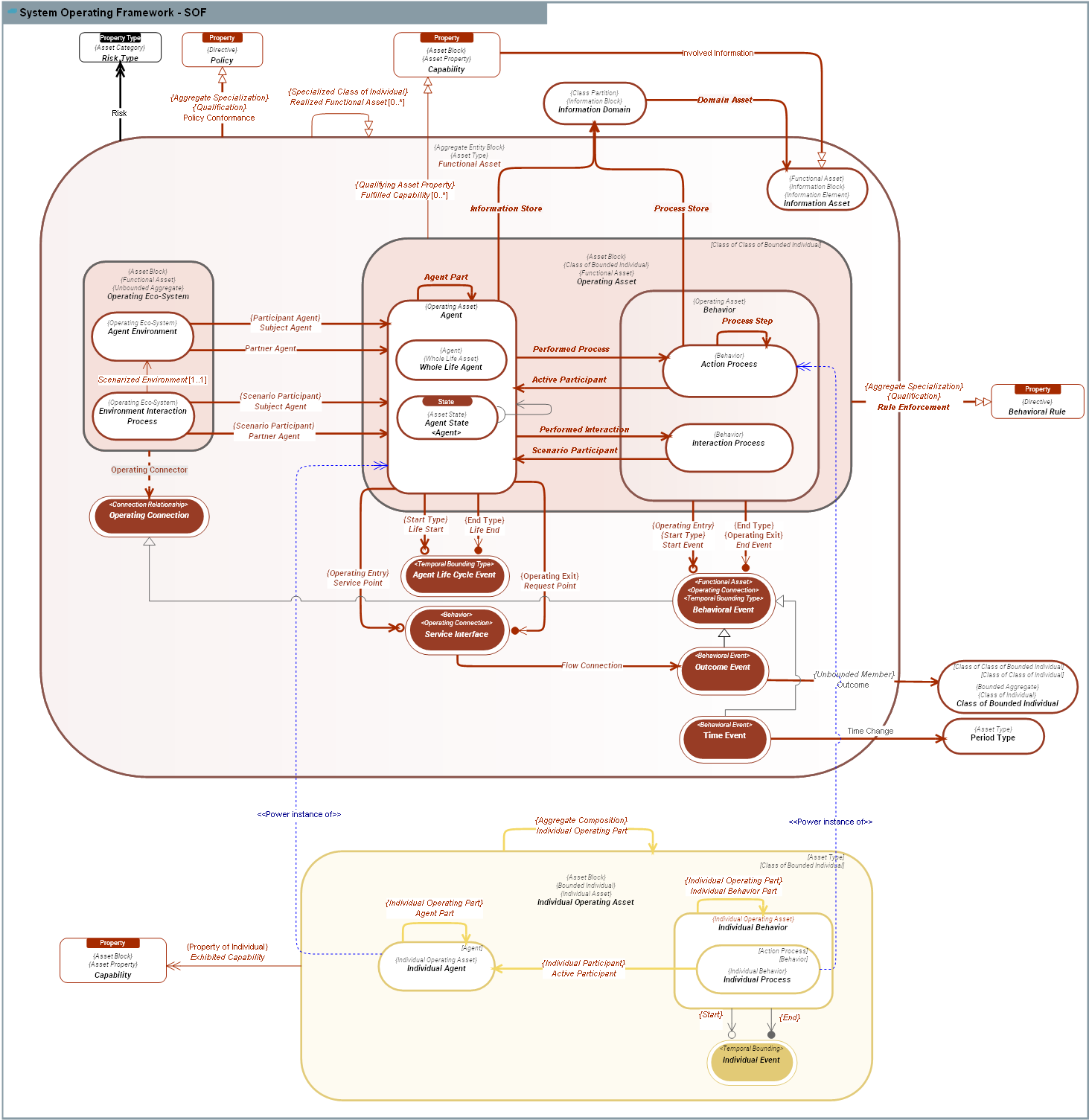
CONCEPT DESCRIPTIONS
ABSTRACT CONCRETE
| Concept | Description |
|---|---|
 Action Process Type
 |
An Action Process Type is a Behavior Type that describes a typical course of action intended to produce Outcomes, through the involvement of Agent Types as Active Participants. During its course of action, a process consumes or produces Functional Assets, including Information Assets. 1) It may memorize or access Information Assets from and to its Process Stores. 2) It may receive Functional Assets at its boundary: Outcome Consumptions. 3) It may signal the production of Functional Assets at its boundary: Outcome Productions. The course of actions of a Action Process Type is constrained ( Rule Enforcement) by the application of Behavioral Rules that define what is allowed and not allowed to do. Within SysFEAT, we can examine Action Process Typees from two distinct perspectives: a) A conceptual standpoint is provided by Value Streams. b) A concrete implementation standpoint is provided by Resource Action Processes.
|
|
Agent Type |
An Agent Type is an Operating Asset Type which is able to participate actively to Behavior Types, to produce and react to Outcome Events. 1. Agent Types participate to Action Process Typees (Active Participant) and/or conduct Action Process Typees (Performed Process). 2. Agent Types participate to Interaction Process Type (Scenario Participant) describing how they interact with other Agent Types. These actions and interactions define Agent Types boundaries described by Service Interfaces.
|
|
Agent Type Environment |
An Agent Type Environment is an Operating Eco-System which defines the interactions (Service Channel) of an Agent Type with its partners (Partner Agent). |
|
Asset Type |
An Asset Type is a Class of Individual which is used in the description of the enterprise and its systems, such as Action Process Typees, Department Types, Applications, Location Types, Period Types.
|
|
Behavior Type |
A Behavior Type is an Operating Asset Type that describes any action or reaction of an Agent Type to external or internal Behavioral Events. Behavior Types include Action Process Typees (action), Interaction Process Types (stories) or interactions (Service Interface). The course of actions of a Behavior Type is constrained ( Rule Enforcement) by the application of Behavioral Rules that define what is allowed and not allowed to do.
|
 Behavioral Event
 |
A Behavioral Event is a Temporal Bounding Type that establishes a temporal connection between Behavior Types. A Behavioral Event connects a Predecessor Behavioral Event, to a Successor Behavioral Event.
|
 Behavioral Rule
 |
A Behavioral Rule is a Directive intended to guide the Behavior of Agent Types, in compliance with enterprise Policy(ies) or regulations. Often, a Behavioral Rule is derived from a Policy. Behavioral Rules are enforced in Processes and Agent Types.
|
|
Capability |
A Capability is a functional Asset Property which refers to the ability to produce an Outcome Event. Capabilitys are fulfilled by Agent Types performing Behavior Types including interactions with other Agent Types to produce Outcome Events.
|
|
Environment Interaction Process Type |
An Environment Interaction Process Type is a story that describes how an Agent Type interacts with its partners (Partner Agent) to achieve Outcome Events in a specific Operating Eco-System (Agent Type Environment). This includes: 1) A course of events represented by Object Flows depicting the succession of intermediate Outcome Events towards the production and consumption of final Outcome Events. 2) Interacting partners who participate to the story in the considered Operating Eco-System. |
 Individual Agent
 |
An Individual Agent is an Individual Operating Asset that exists in space/time and that is able to participate actively to Action Process Typees and/or to conduct Action Process Typees. |
|
Individual Behavior |
An Individual Behavior is an actual instance of Behavior Type that is bounded in time. |
|
Individual Operating Asset |
An Individual Operating Asset is a Functional Asset that describes the way Outcomes are produced and consumed: how (Individual Processes) and by whom (Individual Agents). |
|
Individual Process |
Individual Process is the root instance of Action Process Type.
|
|
Information Asset |
An Information Asset represents anything that can be communicated or memorized by an Agent Type to produce and react to Outcome Events. An Information Asset is either an Information Entity or an Information Property.
The difference lies in their relationship to change and to time. Information Entity(ies) can change over time and have a lifeycle while Information Propertys are immutable characteristics. |
|
Information Domain |
An Information Domain is a family of Information Entity(ies) which constitutes a unit a knowlege required by an Agent Type to operate during Behavior Type execution. |
|
Interaction Process Type |
An Interaction Process Type is a story (Behavior Type) that describes how the components of an Agent Type interacts to produce and consume Outcome Events. This includes: 1) A course of events represented by Object Flows depicting the succesion of intermediate Outcome Events towards the production of the final Outcome Events. 2) Interacting Agent Types who participate to the story.
|
|
Operating Asset Type |
An Operating Asset Type is a Functional Asset that describes the way Outcome Events are produced and consumed: how (Behavior Types) and by whom (Agent Types). Operating Asset Types fulfill Capability(ies) (Fulfilled Capability). As any Functional Architecture Asset, Operating Asset Types are subject to Policy Conformances. In addition, they define Rule Enforcements to indicate how Policy Conformances are met.
|
|
Operating Connection |
An Operating Connection is an Aggregate Connection that defines a behavioral connection between Operating Asset Types. |
|
Operating Eco-System |
An Operating Eco-System is an Operating Context in which an Agent Type exists or lives for a specific purpose, interacting with partners. For instance, the operating context of an enterprise includes its customers and suppliers. |
|
Outcome Event |
An Outcome Event is a Behavioral Event that signals the Output of an Asset Type or state of Asset Type (Outcome) by a producer Behavior Type, ready to be used as an Input by a consumer Behavior Type. |
|
Service Interface |
A Service Interface is an interaction Behavior Type that describes a typical course of Flow Connections, coordinated by Behavioral Events and Outcome Events, and intended to produce Outcomes through the involvement of Agent Types. |


LOGICAL FORMULATION
AGDA RDF