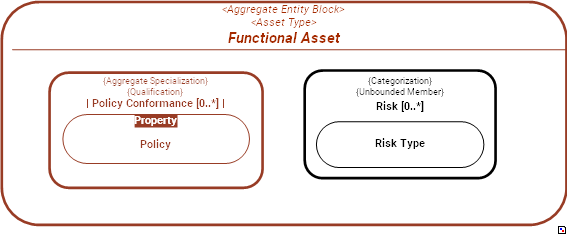
CLASS OF CLASS OF INDIVIDUAL - Functional Asset
| Description |
Abstract Concept
Functional Assets encompasse all Asset Types used to describe why and how systems operate/function. This includes the Operating Eco-System where system operates to fulfill these purposes (Agent Types and their Behavior Types). Functional Assets include: 1. Blocks defining results of Behavior Types of the enterprise or its sub-systems, that benefit to it internal or external customers : Outcome Event, 2. Blocks used to describe information: Information Asset. 3. Blocks used to describe how the enterprise operates: Operating Asset Types (Agent Type, Behavior Type, Service Interface).
Conceptualization Levels of Functional Asset: a Functional Asset is either a Resource Functional Asset or a Conceptual Functional Asset
|
||
|---|---|---|---|
| External references |
 de Weck - The three dimensions of complexity OMG - UAF - Asset OpenGroup - ArchiMate - Element Russell Ackoff - Choice & Communication - FunctionalClass SEBoK - Functional Architecture Wikipedia - Software Functional Architecture WordNet - Product (Production) de Weck - The three dimensions of complexity OMG - UAF - Asset OpenGroup - ArchiMate - Element Russell Ackoff - Choice & Communication - FunctionalClass SEBoK - Functional Architecture Wikipedia - Software Functional Architecture WordNet - Product (Production) | ||
| Super Types |  Asset Type (from partition:
Structural Partition of Asset Type)
Asset Type (from partition:
Structural Partition of Asset Type) | ||
| Dictionary |  SysFEAT System Operating Framework
 | ||
| Lexical Scope |  Architecture Container
 |
RELATIONSHIPS
Simple Graph Graph & Inheritance Table
Simple Graph
Composition: ➝ Classification: ➝ Specialization: ➝ Instance Of: --> Enumerated definition: ➝ Syntax: ➝
LOGICAL FORMULATION
LOGIC-AGDA RDF
File: a44fb6bc6748b088.agda
SEMANTIC TAXONOMY
Sub-Types Super-Types
SUB-TYPES
Click node rectangle to collapse/expand one level. Click triangle for full recursive collapse/expand. Double-click on a node to open its URL. Hover for description.
INTERNAL STRUCTURE