CONCEPT DOMAIN - Compositionality
 Christensen Institute - Modularity
 Martin Fowler - Evans Classification
 SysFEAT - Modularity.pdf

DOMAIN CONCEPT GRAPH
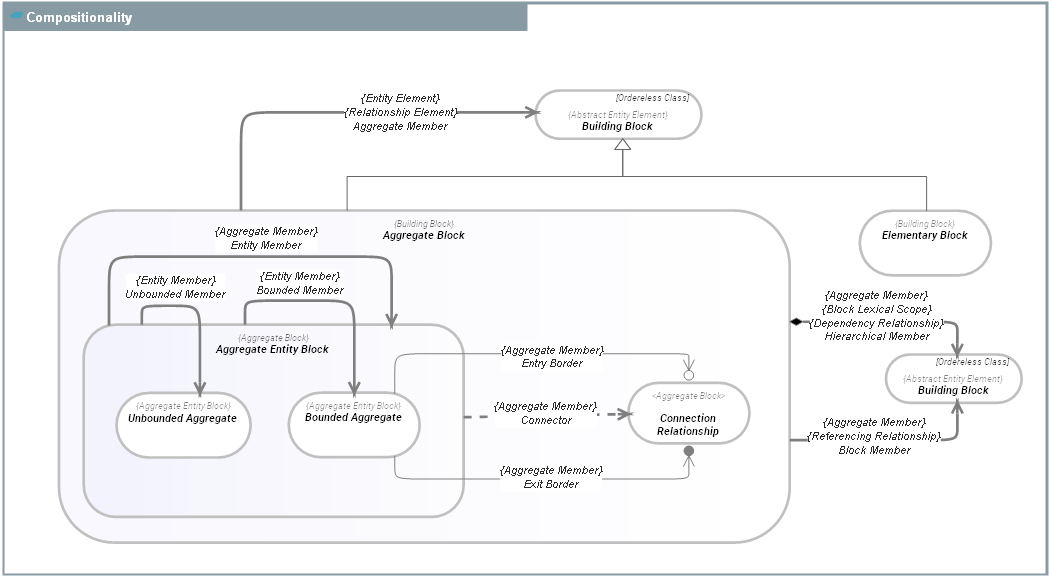
CONCEPT DESCRIPTIONS
ABSTRACT CONCRETE
| Concept | Description |
|---|---|
 Aggregate Block
 |
An Aggregate Block is a Building Block which has an internal structure made of Aggregate Members which, through nesting (Membership of -Aggregate Member-), contextualizes/aggregates (Aggregation of -Building Block (Aggregate Member) - ) external Building Blocks within the Aggregate Block. |
|
Aggregate Entity Block |
An Aggregate Entity Block is a self-contained and independant Aggregate Block that is not an Ordering Connection. Examples: - Operating Eco-System; - Directive; - Agent Type.
|
|
Bounded Aggregate |
A Bounded Aggregate is an Aggregate Entity Block which hides its internal structure to the outside world by means of formal Borders. The only way to access a Bounded Aggregate is through its formal Borders, which ensures the aggregate's internal consistency. The Borders of a Bounded Aggregate is determined by the Ordering Connections it can participate to. Within a Bounded Aggregate structure, Bounded Members can be linked together through Ordering Connectors. The nature of Ordering Connectors is given by their associated Ordering Connection. Examples: - Action Process Typees are bounded by their start and end events (see Behavioral Event).
|
|
Building Block |
A Building Block is an autonomous Entity that contributes to the makeup of other Building Blocks. Building Blocks can be either reusable entities (packaged in Containers) or be local to the Aggregate Block that references them (see Block Lexical Scope and Hierarchical Member). Examples: - Process Steps or Attributes of a data entity ARE NOT Building Blocks. They are members on an internal structure (see Aggregate Member).
|
|
Elementary Block |
An Elementary Block is a Building Block which doesn't have an internal structure. |
|
Ordering Connection |
An Ordering Connection is an Aggregate Block that defines possible connections between the Borders of two or more Bounded Aggregates. Examples: |
|
Unbounded Aggregate |
An Unbounded Aggregate is an Aggregate Entity Block that does not have boundaries and, thereby, that cannot participate to Ordering Connections. Examples: - Directive. |
LOGICAL FORMULATION
AGDA RDF