CONCEPT DOMAIN - Reflexive Knowledge Graph
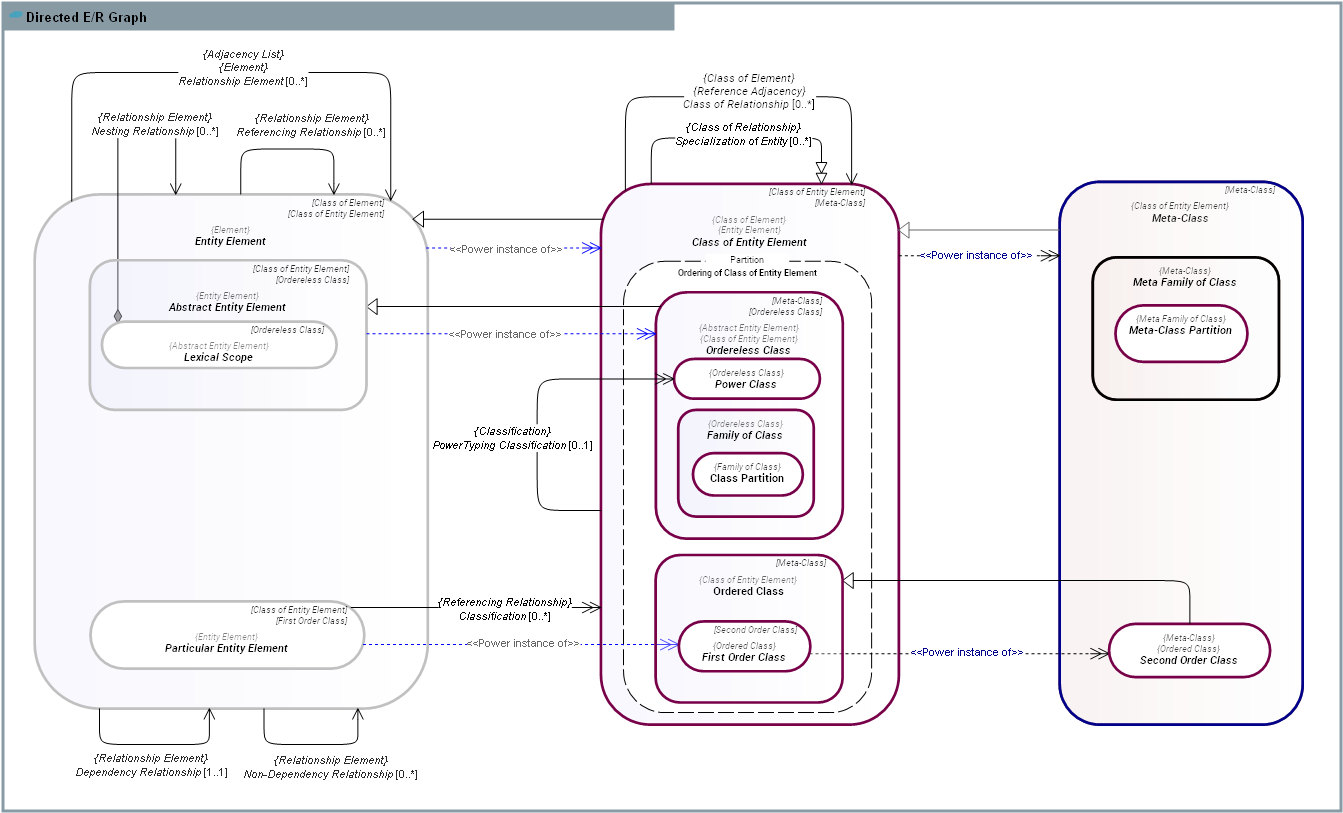
| Description | The Reflexive Knowledge Graph domain defines the top level constructs of Entitys, Relations, their multi-level classification and mereological relationships. It forms the second layer of SysFEAT's graph architecture. In this domain, Relations are refied as first class Elements, allowing them to be further described and qualified. Multi-level classification is implemented by PowerTyping, which enables open and flexible meta-modeling capabilities, This includes support for reflexive meta-modeling, for example allowing Meta-Class to be an instance of itself. Powertyping also applies to relationships, including the Holonymy Relation. This design grounds the Reflexive Knowledge Graph in non-well-founded set theory, ensuring consistency in circular and self-referential structures (see associated external references). The 4D Composite Knowledge Graph provides additional structuring of Entitys and Relations by implementing the Compositionality pattern which establishes the concepts of dynamic locality and connections. |
|---|---|
| External references |
 BORO Research - Unification of Types and Multi-Level Modeling
Matthew West - Ontology meets Business - Non well founded sets BORO Research - Unification of Types and Multi-Level Modeling
Matthew West - Ontology meets Business - Non well founded sets
 Multi-level conceptual modeling: Theory, language and application
OpenGroup - ArchiMate - Top Level Language Structure
Stanford Encyclopedia of Philosophy - Non-wellfounded set theory
SysFEAT-TheoraticalFoundations-MultiLevelModeling.pdf
WordNet - Abstraction
Wordnet - Semantics
WordNet - Typology Multi-level conceptual modeling: Theory, language and application
OpenGroup - ArchiMate - Top Level Language Structure
Stanford Encyclopedia of Philosophy - Non-wellfounded set theory
SysFEAT-TheoraticalFoundations-MultiLevelModeling.pdf
WordNet - Abstraction
Wordnet - Semantics
WordNet - Typology
|
| Dictionary |  SysFEAT Upper Ontology
 |
| Parent Domain |  Upper Ontology
 |
| Domain dependencies |
Predication Substrate |
DOMAIN CONCEPT GRAPH
CONCEPT DESCRIPTIONS
ABSTRACT CONCRETE
| Concept | Description |
|---|---|
 Class of Entity
 |
A Class of Entity is a Class of Element that classifies Entitys. Being a subtype of Entity, it is also an instance of itself. Note: 1) SysFEAT is a higher-order ontology, so Class of Entity may have instances that are also Class of Entity (Class of Classes). 2) SysFEAT is also a non-well-founded and allows for self-referencing Class of Entity.
|
|
Class of Mixed-Order Entity |
A Class of Mixed-Order Entity is a Class of Entity which instances can belong to different meta-modeling order. This includes Class of Entitys that are instances of themselves, such as . |
|
Class of Ordered Entity |
Class of Ordered Entity is the Meta-Class (subtype of Class of Entity and instance of Meta-Class) of all power-type based Class of Entitys that follow a strict ordering of metalevels. |
|
Class Partition |
|
 Entity
 |
An Entity is a distinct, identifiable Element that has a proper existence (living or non living). It is accessible by some referencing mechanism and can have Relations to other Entitys. The Entity class is the powerinstance of Class of Entity: all subtypes of Entity are instances of Class of Entity.
|
|
Family of Class |
|
 First Order Class
 |
First Order Class is the Meta-Class of all subclasses of First Order Entity. Each instance of First Order Class is a Class of Entity, each of whose instances is necessarily a First Order Entity.
|
|
First Order Entity |
A First Order Entity is a kind of Ordered Entity that is not itself a class (Class of Entity): it cannot have instances. The " First Order Entity" class is the powerinstance of First Order Class. First Order Entitys are the most common type of entities. The word "Individual" is sometimes used to designate First Order Entity. In SysFEAT, the term Individual is reserved for First Order Entitys that have a spatio-temporal extent. Examples: . The set of numbers {1,2,3,4}. . The mathematical constant ? (pi). . The English word "Tree" (as a specific string of characters in a specific language). . The Eiffel tower (31st March 1889 - ...). . Mount Vesuvius eruption (Aug. 24-25, A.D. 79). |
|
Lexical Scope |
A Lexical Scope is a kind of Mixed-Order Entity that defines the existence, visibility, and accessibility of the entities nested within it through a Nesting Relation. Nested Entitys have no independent identity or validity outside the lexical or structural scope in which they are defined - they exist only within and for the duration of their parent construct. Every Entity belongs to exactly one Lexical Scope. A Lexical Scope carries no intrinsic semantic meaning; it serves purely as a syntactic mechanism for establishing scope through hierarchical containment. Examples: 1) Composite structures (Aggregate Block) nesting their internal constituents (Aggregate Member). 2) Social structures nesting their roles and functions. 3) Computer functions nesting their local variables or inner functions. 4) Packages nesting their Building Blocks (packaging).
|
 Meta Family of Class
 |
A Meta Family of Class is a Class of Classes of Element (its members are themselves Class of Elements), typically used to group or organize collections of Class of Elements that share some structural, relational, or definitional property. In contrast to families of sets, which are sets of sets, a family of classes operates at a higher ontological level-its elements may represent universes, types, or conceptual groupings rather than individual sets.
|
|
Meta-Class |
Meta-Class (also called Class of Classes of Entity) is the Class of Entity of all Class of Entitys each of whose instances is necessarily a Class of Entity. In other word, Meta-Class is the powertype of Class of Entity: all sub-classes of Class of Entitys are instances of Meta-Class. Since Meta-Class is itself a sub-type of Class of Entity, Meta-Class is an instance of itself.
|
|
Mixed-Order Entity |
Mixed-Order Entity is a class of Entitys that is transversal to order levels, defined polymorphically over the universe hierarchy (for every level u). It is a polymorphic subtype of Entity (declaration: MixedOrderEntity u ⊏⋆ₑ Entity v) and a power instance of Class of Mixed-Order Entity (declaration: ∷ₚₑ), which means that its subtypes may classify entities belonging to any universe level, whereas an Ordered Entity and its subtypes are anchored to a fixed level. A Mixed-Order Entity has no direct instances: it represents an aspect - a transversal characteristic - that an ordered class acquires through the aspect relation (⊏ₐₑ) without giving up its level anchoring. It is the SysFEAT counterpart of MLT*'s orderless type, with two constitutive differences: transversality is carried by the universe polymorphism of the type system (rather than by a FOL axiomatization of integer levels), and cross-level classification goes through the controlled-reflexivity predicates (⊏ₘ, ∷ₘ), which makes it compatible with proof-kernel verification. Example: 1) Aspects of Entitys, such as Lexical Scope. 2) Building Blocks.
|
|
Ordered Entity |
Ordered Entity is a class whose sub-types are classifed by a Class of Ordered Entity: It is the power instance of Class of Ordered Entity. Examples:
|

LOGICAL FORMULATION
AGDA RDF