CONCEPT DOMAIN - Enterprise Glossary
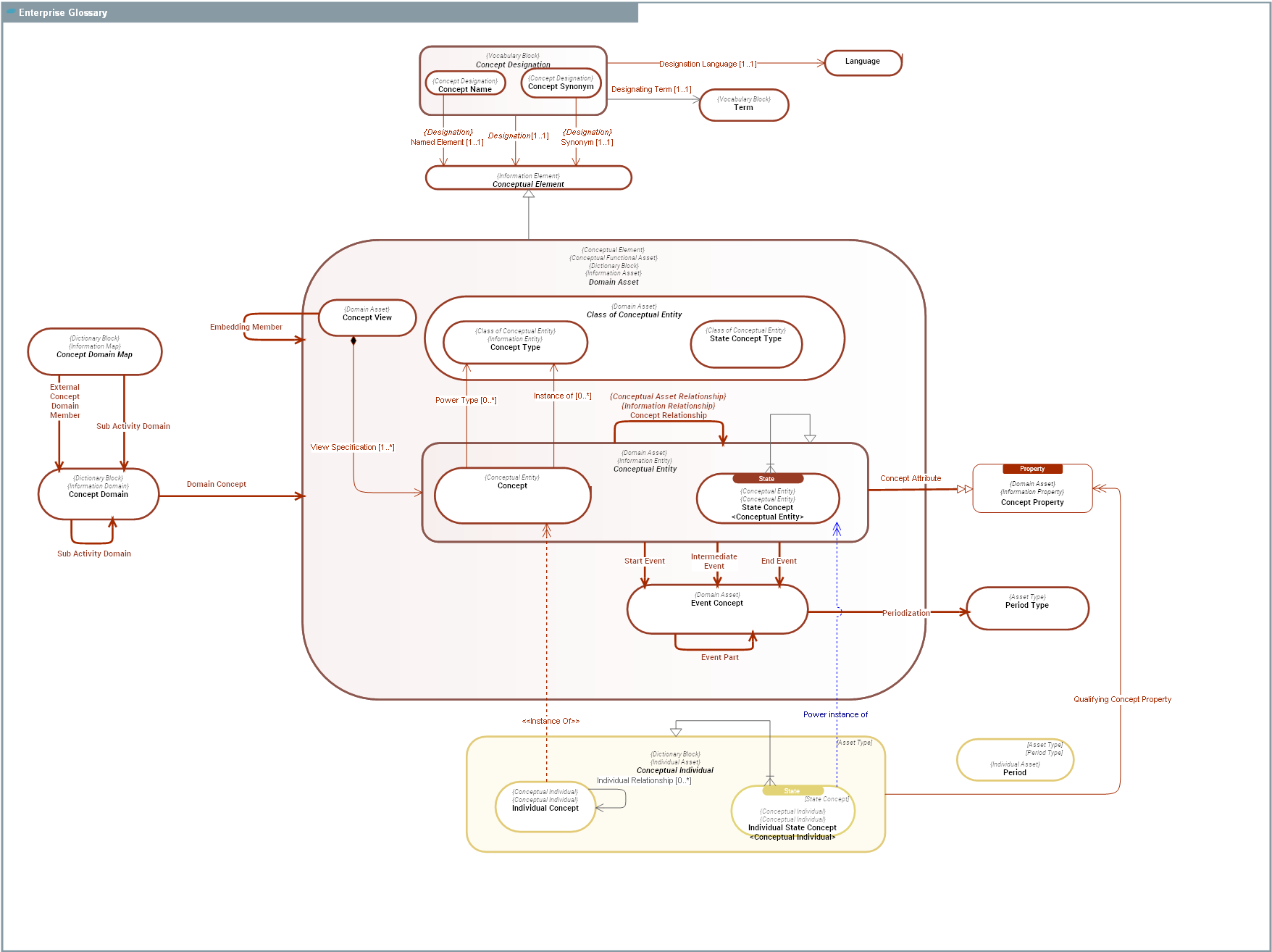
| Description | The Enterprise Glossary domain comprises the Concepts, relationships and Terms used to build the glossary of an enterprise. Dictionary Blocks aim at providing semantic context to Dictionary Assets. |
|---|---|
| Dictionary |  SysFEAT Enterprise concepts
 |
| Parent Domain |  SysFEAT Enterprise Domains
 |
| Domain dependencies |  Architecture Assets
Conceptual Operating Model
Information Assets
Information Packaging
Model Block Packaging
Predication Substrate
Reflexive Knowledge Graph
Architecture Assets
Conceptual Operating Model
Information Assets
Information Packaging
Model Block Packaging
Predication Substrate
Reflexive Knowledge Graph |
| Consuming Method |  Rationalize the use of data in projects
Build the Enterprise Data Glossary
Rationalize the use of data in projects
Build the Enterprise Data Glossary |
DOMAIN CONCEPT GRAPH
CONCEPT DESCRIPTIONS
ABSTRACT CONCRETE
| Concept | Description |
|---|---|
 Class of Conceptual Entity
 |
A Class of Conceptual Entity is a class of concepts which have Conceptual Entitys as instances: Class of Conceptual Entitys classify Conceptual Entitys. |
 Concept Designation
 |
In a given Dictionary Vocabulary, a Concept Designation is a terminological representation that associates a Term to its corresponding Conceptual Element. Example: The term "Effeil Tower" is used in English to designate the metalic tower located near the Seine, constructed by Gustave Eiffel.
|
|
Conceptual Element |
A Conceptual Element is an Mixed-Order Entity that represents the naming aspect of Conceptual Entity Assets and Concept Relationships. |
|
Conceptual Entity |
A Conceptual Entity is the representation of any tangible or intanglible resource or state of such resource that is of interest to understand the enterprises, its data, resources and activities. A Conceptual Entity is either a Concept or a State Concept. Example: - "Person" is a Conceptual Entity of type Concept, Its temporal boundaries are is birth and its death (see Event Concept). - "Employee" is a Conceptual Entity of type State Concept: it is a state of a "person". Its temporal boundaries are its hiring and its departure.
|
|
Conceptual Entity Asset |
A Conceptual Entity Asset is the representation of any type of tangible or intanglible resource, or its respective state, that is critical for comprehending an enterprise, including its data, resources, and activities. Similar to any Information Asset, a Conceptual Entity Asset can be classified into three categories: 1) Conceptual Entitys denote entities that can change over time. 2) Event Concepts embody the temporal boundaries associated with Conceptual Entitys. 3) Concept Propertys represent immutable characteristics of Conceptual Entitys.
|
 Conceptual Individual
 |
A Conceptual Individual is the representation of any actual tangible or intanglible resource, or its respective state, that is critical for comprehending an enterprise, including its data, resources, and activities. |
|
Dictionary Block |
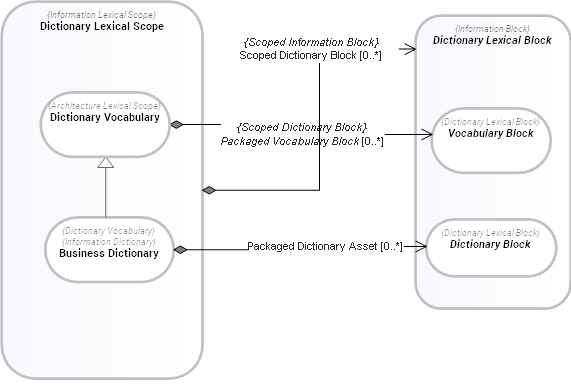
A Dictionary Block is an Dictionary Block involved in informative descriptions of the enterprise. Dictionary Blocks range from Conceptual Entity Assets to Concept Domain Maps.. Conceptual Entity Assets are managed in Data Catalogs. |
|
Dictionary Lexical Block |
A Dictionary Lexical Block is an Information Block that is part of a Business Dictionary. |
|
Dictionary Vocabulary |
A Dictionary Vocabulary is a Model Lexical Scope that provides, for a given Business Dictionary, designation to concepts: Terms, Concept Name and Concept Synonyms.
|
|
Vocabulary Block |
A Vocabulary Block is a Dictionary Lexical Block used in the designation of Conceptual Elements. |
 OMG - SBVR - Designation
 Martin Fowler - Value Object


| Concept | Description |
|---|---|
|
Dictionary Block |
A Dictionary Block is an Dictionary Block involved in informative descriptions of the enterprise. Dictionary Blocks range from Conceptual Entity Assets to Concept Domain Maps.. Conceptual Entity Assets are managed in Data Catalogs. |
|
Dictionary Lexical Block |
A Dictionary Lexical Block is an Information Block that is part of a Business Dictionary. |
|
Dictionary Vocabulary |
A Dictionary Vocabulary is a Model Lexical Scope that provides, for a given Business Dictionary, designation to concepts: Terms, Concept Name and Concept Synonyms.
|
|
Vocabulary Block |
A Vocabulary Block is a Dictionary Lexical Block used in the designation of Conceptual Elements. |
LOGICAL FORMULATION
AGDA RDF